belong to world
Put Carrère in Your Suitcase
One of the most beloved writers of all time meets the story of Teddy in a single word: identity
There are writers who hide behind the characters they invent. And then there is Emmanuel Carrère, who built his entire body of work by doing the exact opposite: putting himself at the center of every story he told, including those involving other people, turning this constant exposure into a method even before a style. He is a writer who never tells a story while remaining offstage, and perhaps that is precisely why millions of readers around the world continue to trust him.
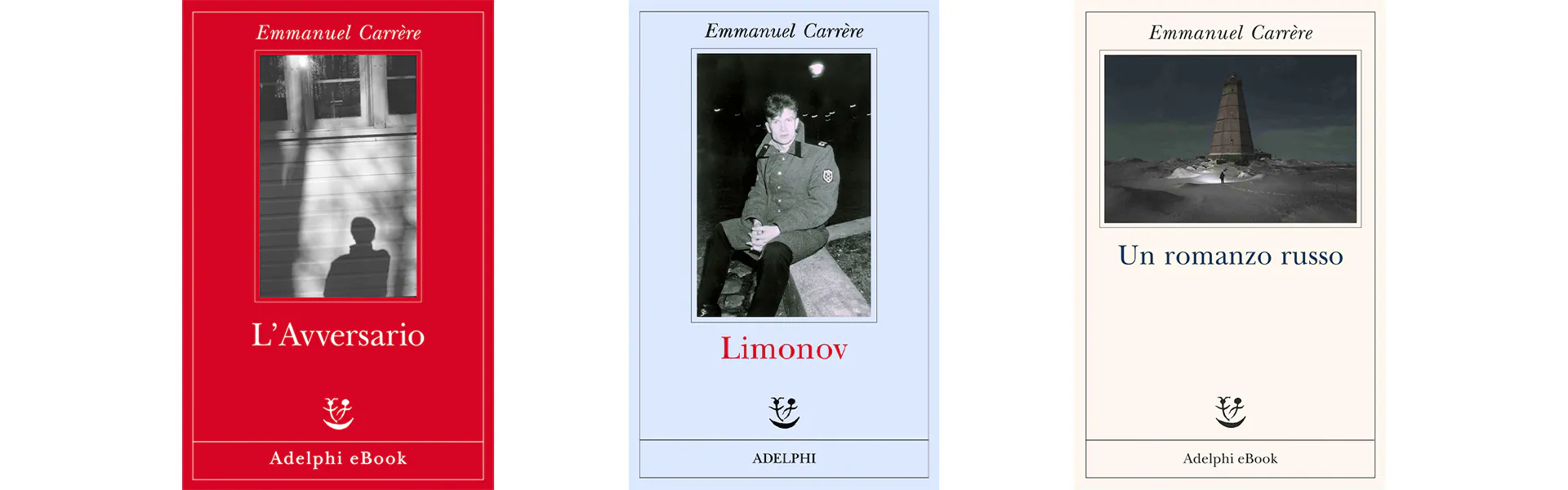
In The Adversary, he enters the life of Jean-Claude Romand, a man who for eighteen years led his wife, children, and parents to believe he was a doctor, ultimately killing them all when the lie was on the verge of collapsing. Carrère could have told it while maintaining the typical distance of a crime reporter. Instead, he chose to show his own struggle to comprehend, his moral doubts, his discomfort at having to give narrative meaning to a horror that has no meaning. In Limonov, he follows the improbable lives of Eduard Limonov—a thug in Kharkiv, an underground poet in New York, a soldier in the Balkans, a Putin opponent—and uses that impossible biography to question how an identity can remain coherent through such radical transformations. In My Life as a Russian Novel, he returns to his own family and origins, stopping before reaching a reassuring truth because he knows that such a truth, if it existed, would be false anyway.
What ties together such different books is not a theme, but a gesture: Carrère refuses to tell a story while remaining outside the scene. Every time he writes about others, he ends up writing about himself, his own contradictions, and his limits in judging those in front of him. It is a method that exposes the author more than it exposes his subjects, and precisely for this reason, it generates a trust that detached journalism rarely manages to build. It is also, if you think about it, an exercise in identity: understanding who you are by thoroughly telling who others are.
This year Carrère returned to bookstores with Kolkhoz, released just a few weeks ago, winner of the Prix Médicis and a finalist for the Prix Goncourt, already one of the most talked-about titles of the literary season in France and beyond. There is no need to delve into the details of the book to understand why it matters: it is enough to know that it confirms once again how his way of writing—putting himself unreservedly into the story—continues to resonate with readers worldwide, at a time when autobiographical writing always risks slipping into exhibitionism or self-absolution. Carrère avoids both traps, doing so with a discipline worth observing closely, especially for those tasked with telling something other than a novel. Because the question his writing has posed for twenty years concerns anyone constructing a narrative of themselves, whether a book, a project, or a company: how much are we truly willing to show, uncomfortable parts included, instead of limiting ourselves to a sanitized, ready-to-be-approved version?

It is an uncomfortable question because the honest answer almost always requires giving something up. Giving up total control over the image offered to others. Giving up the idea that telling one's story well means telling it without rough edges. Carrère built an entire career on this surrender, and his readers have rewarded him precisely for it: because when someone truly shows themselves instead of merely communicating, the reader senses it and believes them.
There is another book that brings this same question much closer to home. Il socio di minoranza ("The Minority Shareholder"), by Marco Bardazzi and Marco Lessi, tells the story of Vittorio Tadei, the founder of Teddy: the son of a railway worker who, from Rimini, built a company that went global, with brands like Terranova, Rinascimento, Calliope, and QB24 present worldwide. Bardazzi and Lessi reconstruct the key milestones of that story by giving voice to children, grandchildren, collaborators, and the many people who spent years by Vittorio's side. In doing so, they repeatedly return to a question that runs throughout the book: who is truly the "majority shareholder" Tadei often referred to? What does it mean to remain, at heart, always a fashion outsider—someone who chose trust over formulas to build something that truly resembled him?
It is the same question that drives Carrère's books, posed within an entrepreneurial story instead of a novel. Il socio di minoranza also tells of an identity built through work, staying true to an idea even when it would be easier to adapt to proven models. Teddy was born from exactly this: from a person who chose to be recognizable rather than conventional, and from a company that inherited that same posture, preferring to describe itself as it is rather than as it would be more convenient to appear.

Reading Carrère and reading Il socio di minoranza during the same period—perhaps during the same vacation month—means comparing two ways of telling the same thing: that identity is an ongoing project made of choices repeated over time until they become character. This holds true for a French writer digging into his own family without sugarcoating it. It holds true for a Romagna entrepreneur who built an empire by staying faithful to an idea of trust rather than formulas. And ultimately, it holds true for those working inside Teddy today who find themselves recognizing something of their own while reading that story.
Take them both on vacation. And let that question linger about what it truly means to show oneself without filters—whether in a novel, a family, or a company that still bears the name of the man who founded it.