belong to world
Everyone happy on LinkedIn? The social network where work becomes a story
Between increasingly similar languages and corporate narratives seeking authenticity, Andrea Prosperi (People Care Director of Teddy Group) reflects on how LinkedIn is a real space for sharing work and its deepest purpose.
In the early 2000s, in the heart of Silicon Valley, LinkedIn was born: what is now, for all intents and purposes, the primary platform for entering the world of work, pivoting one's career, and engaging with professionals and intellectuals who have made work, business, and personal growth the center of their educational outreach.
In recent years, LinkedIn has evolved, transforming into a public space where companies narrate their identity, professionals share journeys and results, and work - once confined to offices and resumes - takes the form of a daily narrative. Scrolling through the feed, one encounters stories of new beginnings, successful projects, growing teams, and people changing roles or perspectives. It is a global conversation on work: thousands of small professional chronicles that together build the image of how we work today.

Focusing for a moment on the language, there is a particularly striking aspect: the way these stories are told. Many posts seem to speak a surprisingly similar language. The recurring words are those of enthusiasm and gratitude: people are "proud to share," "happy to announce," "grateful for this opportunity." Projects are "incredible," colleagues "extraordinary," and experiences "exciting."
At this point, an interesting question arises: does this language truly describe the complexity of contemporary work, or has it become, at least in part, a performative space? The issue concerns us closely, as for us, LinkedIn is a free space to share everything about our work: from the Dream of our founder, Vittorio Tadei, to the purpose that is its natural heir. Starting specifically from what distinguishes us most—a purpose that challenges us to dress the world with beauty and hospitality while fostering personal fulfillment—we asked ourselves: who are we on LinkedIn, and how do we tell our most authentic essence?
Andrea Prosperi, People Care Director of Teddy Group, responds this way:
«On our part, there has never been a strategic calculation on how to present ourselves. We tell our company story on LinkedIn just as we tell the company story during a school visit or to a colleague we invite to lunch. We describe ourselves with realism because that is just who we are.» But there is more. According to Prosperi, the possibility for interaction guaranteed by the platform and the resulting tone limit that tendency toward emphasis sometimes encountered while scrolling through feeds. «Old brochures were more emphatic, after all, when no one could comment.»
But let us now reach the heart of the question: how does what actually happens transform into an occasion for storytelling, and what form does this story take when it passes through LinkedIn?
«It is a matter of approach. The same work circumstance can be experienced as a tragedy, an opportunity for improvement, or a normal routine, depending on how strong the connection is to the ultimate goal of one's work. The stronger this connection, the more even complex circumstances are read positively. The more I am engaged, the more I see unexpected events as a normal aspect of a job I like and find satisfying. If this engagement is missing, the problem becomes the work itself: I no longer know why I am doing what I am doing and, consequently, all that remains is the difficulty.»
And it is precisely this link to the meaning of work that, according to Prosperi, makes LinkedIn an interesting tool.
«We have a good link with the ultimate purpose of our work. In this sense, LinkedIn can be a partner for dissemination and sharing. I like the philosophy of LinkedIn because it gives me the idea of being connected: an idea that has much in common with us and that is useful to the extent that it helps us share the ultimate purpose and results, not just the practical ones of our work.»
How, then, does LinkedIn become a tool for extending and communicating Teddy's purpose?
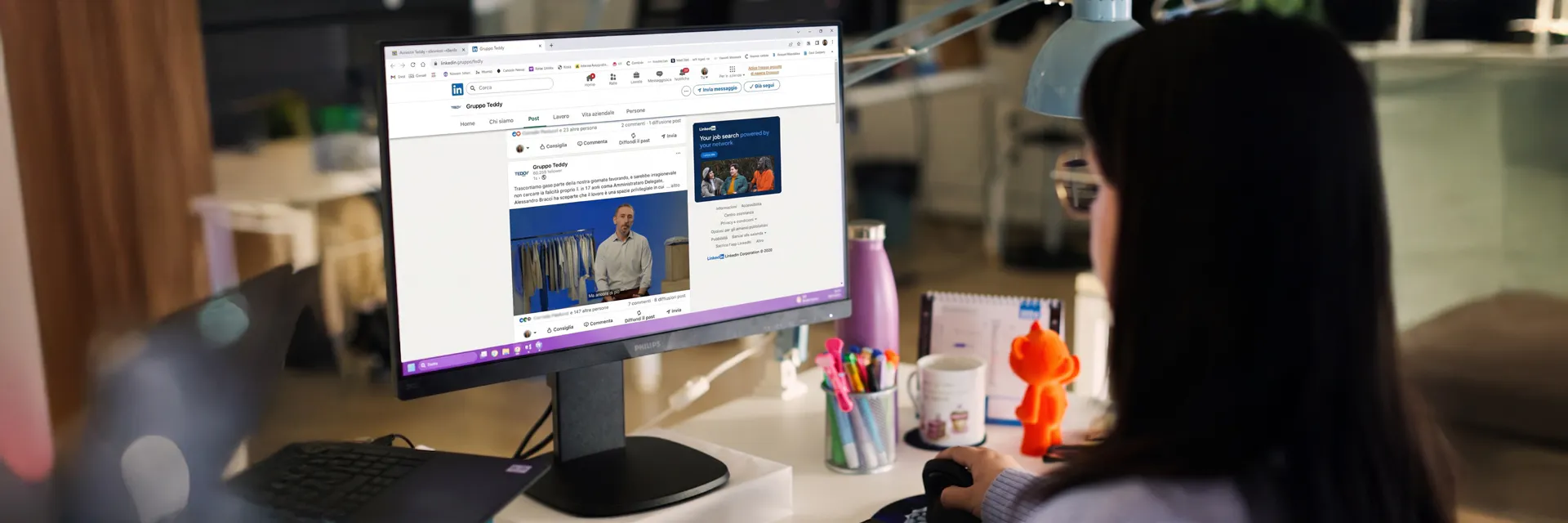
«LinkedIn allows for the sharing of corporate life in its fullest sense. The interesting thing is that when this type of communication is done - rather than the mere sharing of job openings - the page comes alive, receives more interest, and applications also increase, because people perceive they are joining an organization that has a purpose.» According to Prosperi, it is fundamental that LinkedIn remains a conscious tool. «It is becoming increasingly important and present in the world of work because it contributes to building people's professional identities. Soon, perhaps, we will no longer see resumes, but only LinkedIn pages.» Meanwhile, the HR world is increasingly influenced by emerging technologies and artificial intelligence applied to recruiting.
In this context, does the story that the company - and its employees - tell of themselves in the space offered by LinkedIn become a true opportunity?
«On the company side, compared to a cold advertisement, LinkedIn immediately gives the possibility to share something more about corporate life. Today, it is increasingly the candidate who chooses the company. Similarly, for the recruiter, the LinkedIn page helps provide elements about the candidate that are impossible to communicate via a resume. Profiles that truly tell something about themselves are the ones that make a difference. But this kind of storytelling is only possible when one is passionate about their work.»
Can LinkedIn also contribute to changing the very conception of work?
«Companies, in the beauty of their diversity, have different conceptions of work. We look for people who see work as an area where they can express and realize themselves. That this is possible is demonstrated by the stories of the people who work at Teddy, who experience exactly this way of understanding work here. The more vivid the page telling the life at Teddy is, the more those who encounter us have the chance to know us and discover what happens in our workplaces.»
Real work, after all, is rarely linear. It is made of attempts, adjustments, changes of course, and intuitions that mature slowly. Above all, it is made of relationships. Not all of this fits into the public narratives of companies. But when it does, it changes the tone of the conversation. The point, ultimately, is not deciding whether LinkedIn is a performative or authentic space. The point is how we intend to use it: choosing to communicate to generate and build value, or as a mere showcase, as if it were, in the end, one of those old brochures. The difference is made by the ability to tell the story of work as what it truly is: a shared human experience that helps us discover who we are.